From 15 to 17 October 2026, Hotel Osijek hosted the 6th Croatian Congress on Pain Management with international participation, organised by the Croatian Pain Society of the Croatian Medical Association. The congress brought together healthcare professionals from a range of fields to share experience and present contemporary approaches to treating acute and chronic pain.
Byteink took part as a bronze sponsor of the congress. At our exhibition stand we presented MediCare Companion, our own digital platform focused on tracking pain, organising relevant health data and connecting patients more closely with healthcare professionals.
For our team, the congress was an opportunity to look at the development of health technology in the context of real clinical needs, and to think further about how data collected between appointments can support more individualised care.
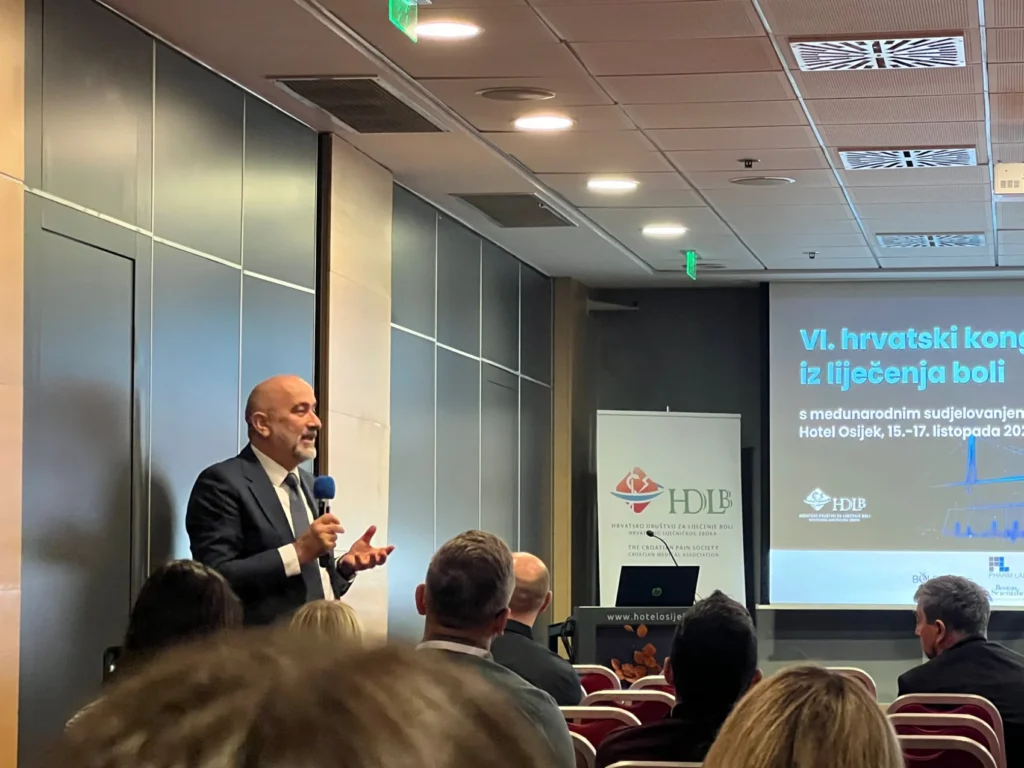
Chronic pain calls for more than a single therapeutic response
Chronic pain can affect sleep, movement, emotional wellbeing, the ability to work, family relationships and quality of life. Treating it therefore requires an understanding of the different mechanisms behind pain and of each patient’s individual circumstances.
The congress programme brought together pharmacological and interventional procedures, rehabilitation, psychological approaches and questions of palliative care. The shared message was the importance of a multidisciplinary approach and of treatment goals that go beyond reducing symptoms to include better everyday functioning.
Cognitive-behavioural techniques: the link between pain and daily activities
In her talk “Cognitive-Behavioral Techniques in Chronic Pain Management: From Theory to Clinical Practice”, psychologist Iva Dimitrijević, MA, presented the connections between thoughts, emotions, behaviour and the experience of chronic pain. The techniques covered included psychoeducation, cognitive restructuring, relaxation, behavioural activation and activity pacing.
Some patients may experience a cycle of overactivity, worsening symptoms and periods of reduced activity. Recognising such patterns is important for planning realistic daily activities and tailored coping strategies.
Where does digital monitoring fit in?
Recording pain over time, alongside available data on movement and other health indicators, can help professionals and patients discuss possible patterns of change. MediCare Companion is designed to support this kind of continuous monitoring between follow-up appointments.
Such records are not a substitute for cognitive-behavioural therapy, nor do they by themselves prove the cause of pain; their value lies in providing additional context for professional assessment.
Holistic pain assessment: a patient is more than a number on a scale
One of the congress’s particularly important topics was pain assessment in palliative care. The 0–10 numerical pain scale is important for tracking intensity, but it says little about what pain means for a particular patient.
The concept of total pain, associated with the work of Cicely Saunders, encompasses the physical, psychological, social, spiritual and existential dimensions of suffering. A comprehensive assessment also includes the impact of pain on sleep, activities, family relationships and quality of life.
A pain intensity score alone is not enough to understand the patient’s whole experience.
Standardised questionnaires and digital tools can complement assessment, but they cannot replace conversation with the patient and clinical judgement.
From monitoring to multidimensional assessment: our development vision
These expert perspectives encourage us to consider a more advanced model of multidimensional pain assessment (pain scoring) as we develop MediCare Companion. The idea is to bring several sources of information together into a structured view of the patient’s condition:
01 · Patient’s assessment
Pain intensity, characteristics and changes over time.
02 · Health indicators
Sleep, steps, blood pressure, heart rate and other available data.
03 · Questionnaires
SF-36, painDETECT, HADS and other appropriate validated instruments.
SF-36 measures health-related quality of life, painDETECT possible neuropathic features of pain, and HADS symptoms of anxiety and depression. These are different measures and cannot simply be added up into a single pain score. Likewise, sleep, steps, blood pressure and heart rate are not direct measures of pain.
This is a possible direction for further development, not an existing clinically validated result. Responsible use of such a model would require expert methodology, evaluation of its usefulness and clinical validation.
Byteink’s stand: MediCare Companion in conversation with the professional community
At the congress we presented MediCare Companion as a digital platform that supports continuous pain logging, tracking of relevant indicators and the exchange of information between patients and their healthcare teams.
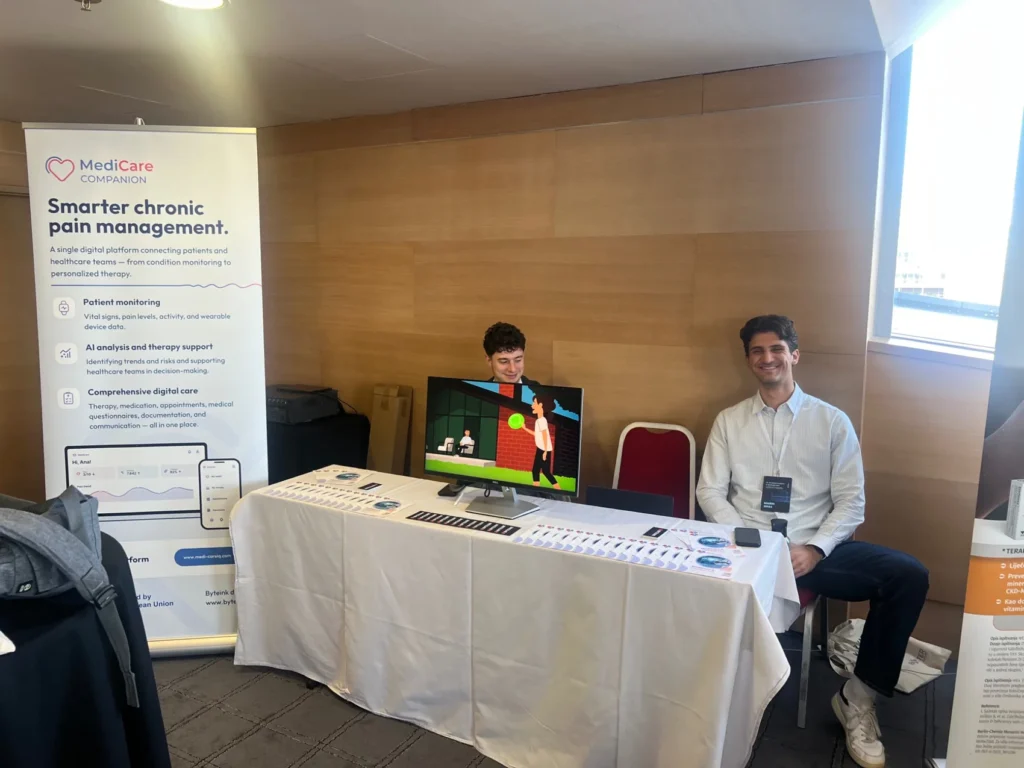
Chronic pain doesn’t stop between two doctor’s appointments. Neither should tracking it.
For Byteink, developing our own health product means connecting technical capabilities with the concrete needs of patients and healthcare professionals. Continuous monitoring and better-organised data can be important steps towards more informed and more individualised care.
Technology in the service of better care
The 6th Croatian Congress on Pain Management in Osijek reminded us how important collaboration between different professions is for progress in medicine. Insights into behavioural approaches and holistic pain assessment are valuable guidance as we think about future MediCare Companion features.
We thank the Croatian Pain Society for organising the congress and for the opportunity to take part as a bronze sponsor. We will keep developing digital solutions that put technology in the service of people.
Discover MediCare Companion
Learn more about Byteink’s platform for digital support in monitoring and managing chronic pain.
Note: This article is for information only and is not a substitute for medical advice. The multidimensional pain scoring model is described as a development possibility, not as a clinically validated product feature.